Incomplete fictional draft
Police activity near the park. Avoid the area.
The issuer, boundary, time and source of the current instruction are unclear. A reader cannot tell which entrance or when the instruction applies.


Research and practice · Original resource / 03
What makes an alert understandable, how different channels fit and what an evaluation can actually establish. A sourced review with original examples and tools.
A useful warning helps someone decide whether it applies to them and what they should do. A notice that says only “police activity nearby” can attract attention while leaving its audience unsure of the affected place, timing or next action. The responsible authority supplies the incident facts and appropriate instruction; this guide examines how that information is communicated.
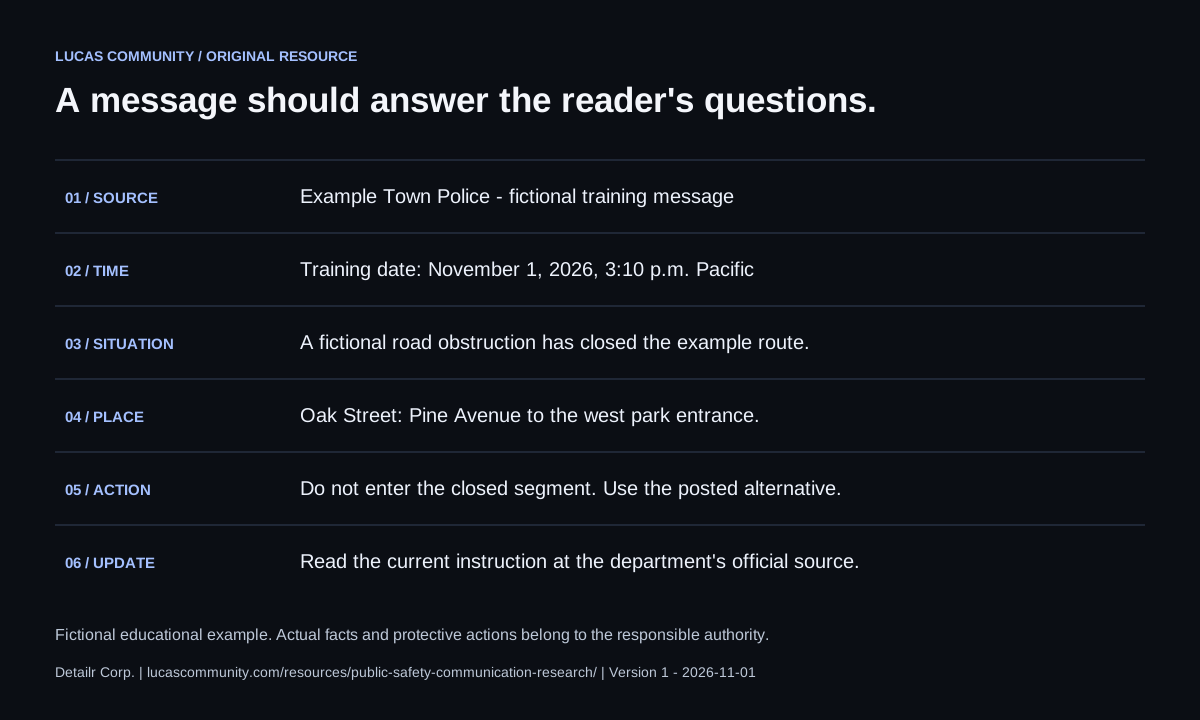
FEMA training identifies source, hazard, location, timing and protective behavior among the content a warning needs. The original diagram below translates those components into an editorial review aid. It is not a message template approved for every hazard or a substitute for an agency’s warning policy.
Example Town Police · Fictional training message
Exercise date: November 1, 2026 · 3:10 p.m. Pacific
A fictional road obstruction has closed the example route.
Oak Street between Pine Avenue and the west park entrance.
Do not enter the closed segment. Use the posted alternative.
Read the department’s current message at its official source.
This example teaches message structure. It is not a current instruction, a real agency message or an approved all-hazard template. The responsible authority supplies actual facts and protective actions.
Download the original diagram · SVG ↓NIST’s imminent-threat guidance recommends understandable source, hazard, area, timing and protective-action information. Its language guidance favors familiar descriptions and reduced jargon. Here, the practical question is whether a reader can identify the actual boundary and action without knowing the department’s internal abbreviations.
Give a reader the same context they would have on a phone, rather than explaining the scenario first. Ask them to point out the affected area and say the requested action in their own words. A map can reinforce a boundary, but a reader should not have to infer an instruction from a blue shape alone.
FEMA’s IS-247.C summary recommends plain language, equivalent audio and text, an explanation for images or maps, and attention to the population’s primary languages. It also recommends checking automated translations with a speaker of the language. These are review tasks, not properties guaranteed by adding a translation button.
Check the complete instruction with the formats people will actually use. Listen to spoken output, enlarge the text, read the message without its image and have the planned language versions checked. Confirm that a translated boundary, time or action still means the same thing. Include residents who use the relevant formats in an appropriately planned exercise.
Source: IS-247.C Course Summary: Integrated Public Alert and Warning System (IPAWS) for Alert Originators ↗
A 2024 study by Carlson and colleagues randomized 481 U.S. adults to mock warning messages in five 90/360-character pairs. Longer complete messages did not increase intended compliance overall in that experiment; both versions contained core warning elements. That finding does not establish that length never matters.
The exposure was hypothetical and the outcome was self-reported intention, not observed behavior in an emergency. The practical implication is to test a message’s content and interpretation within the limits of its channel. Do not remove a critical location or action simply to make a message shorter, and do not treat a longer message as proof it works better.
CISA’s alerting guidance recommends multiple channels for reach and corroboration and warns about irrelevant messages consuming public attention. A dedicated app, a local opt-in system, a public webpage and an authorized warning broadcast can have complementary roles. Their recipient models and operating permissions need to be checked separately.
For a specific event, identify who is affected, the urgency, the approved warning authority and the available pathways. Keep the core instruction consistent while adapting the format. Preserve alternatives for people without a particular app, account, connection or compatible device. A police activity archive answers a historical question; it should not be presented as a current warning.
Source: Ten Keys to Improving Emergency Alerts, Warnings & Notifications ↗
CDC’s crisis-communication guidance discusses the difficulty of processing complex information under stress and recommends clear communication about what is known and unknown. That supports a useful editorial separation: confirmed facts, the instruction currently in force and what is still being checked.
Do not fill a gap with an explanation that has not been verified. Put an update time and responsible source beside the current instruction. The fictional correction example below changes a boundary without pretending that every reader saw the first notice. The issuer remains responsible for release decisions and for protecting information that cannot be made public.
Source: CERC: Psychology of a Crisis ↗
Original editorial examples
Incomplete fictional draft
Police activity near the park. Avoid the area.
The issuer, boundary, time and source of the current instruction are unclear. A reader cannot tell which entrance or when the instruction applies.
More specific fictional draft
Training example, November 1, 2026, 3:10 p.m. Pacific: Example Town Police report a road obstruction on Oak Street between Pine Avenue and the west park entrance. Do not enter that closed segment. Use the posted alternative and check the department’s current update.
The added detail supports an interpretation check. It is not evidence that the revised wording produces safer behavior.
“Training update, 3:25 p.m. Pacific: the earlier Oak Street closure now ends at Cedar Avenue, not the park entrance. Follow the current posted boundary. This update replaces our 3:10 p.m. exercise message.”
A real publisher must confirm the change, decide the approved instruction and make the updated source discoverable. The example only illustrates version, time and correction ownership.
A USGS publication record describes a framework for post-alert messaging developed for ShakeAlert earthquake early warning. We reviewed its abstract, not the full study, and do not treat its findings as an all-hazard communication standard. Its narrower context still prompts a useful planning question: what information will people need after the initial attention signal?
For a local communication exercise, identify who posts the next update, where it appears and how an ended or corrected condition is distinguished from an older message. A request for camera footage also needs a clear response route and expectations. It should not lead a resident to assume that a submission is monitored immediately.
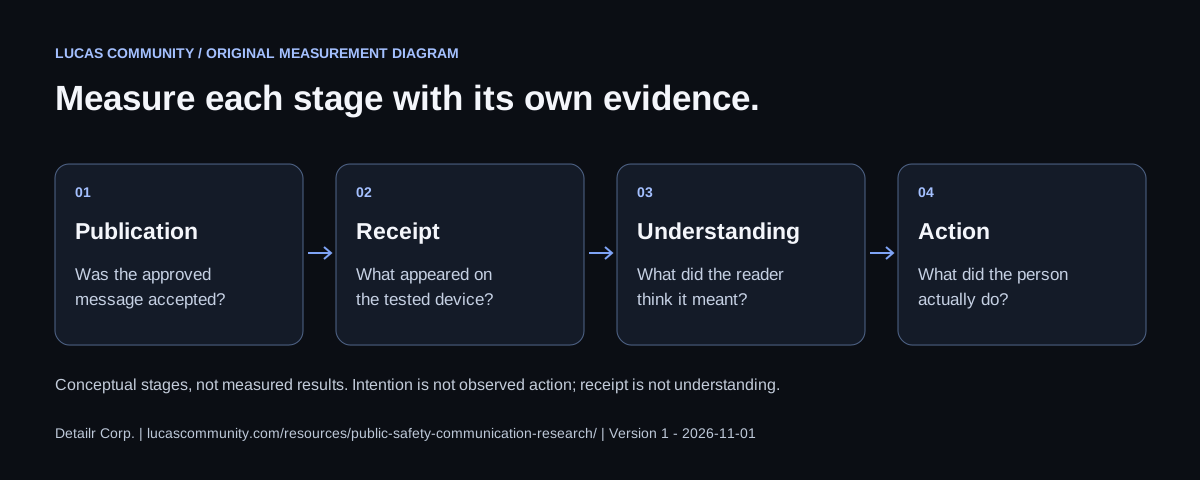
A system’s acceptance of a send, a notification appearing on a device, a reader understanding the instruction, a stated intention and an observed action are different observations. None alone establishes a reduced injury rate, a solved case or a faster emergency response. The measurement diagram below shows why these stages should not be collapsed into one success percentage.
Record the denominator, missing observations and conditions for each proposed measure. A small comprehension exercise can identify confusing wording. It cannot estimate the behavior of everyone in a jurisdiction or establish a product’s effectiveness during a real incident.
Original conceptual diagram
Did the system accept the approved message?
What appeared on the tested device, under which settings?
What did the reader think applied to them?
What did the person actually do?
No stage is a measured product result here. Each needs its own method, denominator, conditions and missing-observation record. Self-reported intention is also distinct from observed action.
Download the original diagram · SVG ↓NIST’s building-communication guidance distinguishes language, readability and response testing and describes paraphrase and usability methods. Our proposed exercise adapts that testing approach outside its building-specific context. Use clearly labeled fictional material and informed participants; do not issue a real public alert to test copy.
Write the intended interpretation before the session. Show the message in its planned format without coaching, ask open-ended questions, record the participant’s words and then revise what is unclear. Include relevant languages and access needs in the plan. Keep identifiable participant or case information out of this website and use an agency-approved records process for any real evaluation.
Source: General Guidance on Emergency Communication Strategies for Buildings, 2nd Edition ↗
Record interpretation, remaining ambiguity and the proposed revision in your own approved notes.
Record interpretation, remaining ambiguity and the proposed revision in your own approved notes.
Record interpretation, remaining ambiguity and the proposed revision in your own approved notes.
Record interpretation, remaining ambiguity and the proposed revision in your own approved notes.
Keep a blank cell blank when there is no observation. Do not convert one person’s interpretation or a convenience sample into a jurisdiction-wide compliance percentage. This protocol has not been run for Lucas or Sentinel; no results are reported.
Lucas is the resident app; Sentinel is the department workspace. Their intended connection is a department’s message, a resident’s relevant observation and an accountable agency review. An evaluation can examine whether that connection is understandable and workable in the current release.
The material here is guidance and original editorial application, not published Lucas pilot findings. No participating department, delivery benchmark, security certification or operational outcome is established by this review. When verified pilot evidence exists, it should be published with a protocol, version, sample, missing observations and limitations rather than added as an unattributed success claim.
Bounded narrative evidence review, not a systematic review or meta-analysis. Consulted content/source-claims.json first and reused three unchanged guidance records with their existing verification dates and retrieval limits. Searched for primary official guidance and original research covering message content, dissemination, accessible language, uncertainty, follow-up and comprehension testing. Selected eight sources with different practical roles. Reviewed relevant full-text sections when retrievable and recorded abstract-only access explicitly. Kept operational guidance, evidence syntheses, original experiments and this publisher's proposed applications distinct. No numerical findings were pooled.
New research was reviewed November 1, 2026. Reused guidance retains its original October 26 or 27 review date in the source notes. Selection focused on message content, audience access, uncertainty, channel fit and testing. No quantitative results were pooled.
Official training guidance. Components of public warning messages.
Evidence reviewed: 2026-10-26 America/Los_Angeles. Existing register: source or documented source locator reviewed; reused primary research or original consumer-policy capture. No new full-body review claimed.
Guidance for public warnings, not empirical evidence that Lucas improves safety. Severity and exact advice must be supplied by the responsible authority.
Official crisis-communication guidance. Information processing and communication during crises.
Evidence reviewed: 2026-10-26 America/Los_Angeles. Existing register: source or documented source locator reviewed; reused primary research or original consumer-policy capture. No new full-body review claimed.
No permission to publish sensitive investigative details. The responsible agency determines what it can release. Applying this guidance to a software workflow is an editorial inference, not a validated intervention.
Official operational guidance. Emergency alert, warning and notification program practices.
Evidence reviewed: 2026-10-27 America/Los_Angeles. Existing register: official indexed PDF text reviewed, including a page-number locator; direct open returned 403.
Official indexed substantive text was reviewed in the earlier task; direct PDF retrieval returned 403. No full-body read is claimed. Department vetting alone does not eliminate fatigue or establish relevance. A central workflow complements official channels.
Evidence-based guidance developed from literature reviews and expert input. Imminent-threat outdoor sirens and short messages; section 4.2 concerns short-message alerts.
Evidence reviewed: 2026-11-01 America/Los_Angeles. Official landing page and full PDF retrieved. Reviewed metadata, guidance-development methods and section 4.2, printed pages 14–16 (PDF pages 18–20).
This is a research synthesis and guidance document, not a new randomized outcome study. Its platform descriptions reflect 2018 and must not be used as current WEA specifications.
Evidence-based guidance, with message-testing methods. Emergency communication in buildings; this resource borrows the comprehension-testing approach with that setting stated.
Evidence reviewed: 2026-11-01 America/Los_Angeles. Official full PDF retrieved. Reviewed cover/date, executive-summary scope and section 6, printed pages 25–29.
A comprehension session does not measure real emergency behavior or prove a safety outcome. This resource proposes a labelled, voluntary tabletop exercise and no live alert transmission.
Official alert-originator training guidance. Unit 5 considerations for effective alerting, language and access/functional needs.
Evidence reviewed: 2026-11-01 America/Los_Angeles. Official full course-summary PDF retrieved; relevant Unit 5 text reviewed, including extracted lines 422–431. Course date verified in official overview search text.
Platform capability does not by itself establish that a specific alert is accessible. Do not copy historical language-support or device specifications as current universal capabilities.
Original randomized mock-message experiment. 481 U.S. adults in an online panel saw one of ten mock messages: five paired 90/360-character examples. Data collected September 25–28, 2022.
Evidence reviewed: 2026-11-01 America/Los_Angeles. Full author manuscript retrieved; reviewed abstract, methods, results/discussion and limitations.
Hypothetical exposure and self-reported immediate intentions are proxies for behavior. The sample and scenarios do not establish all audiences, hazard-specific performance or Lucas/Sentinel outcomes.
Original research/framework development; abstract-level review here. Post-alert messaging for the West Coast ShakeAlert earthquake early warning system.
Evidence reviewed: 2026-11-01 America/Los_Angeles. Official USGS publication page opened and abstract reviewed; full article not retrieved.
Only the official abstract and metadata were reviewed. The warehouse and publisher link returned 403. This does not establish a quantified trust benefit or validate a general police-update protocol.
Reference resources
24 evidence questions, four tabletop scenarios and a downloadable checklist.
For source finding78 curated resources, with service types, actual review dates and scope limits.
For clearer communicationPrimary research, original diagrams and a repeatable comprehension exercise.